

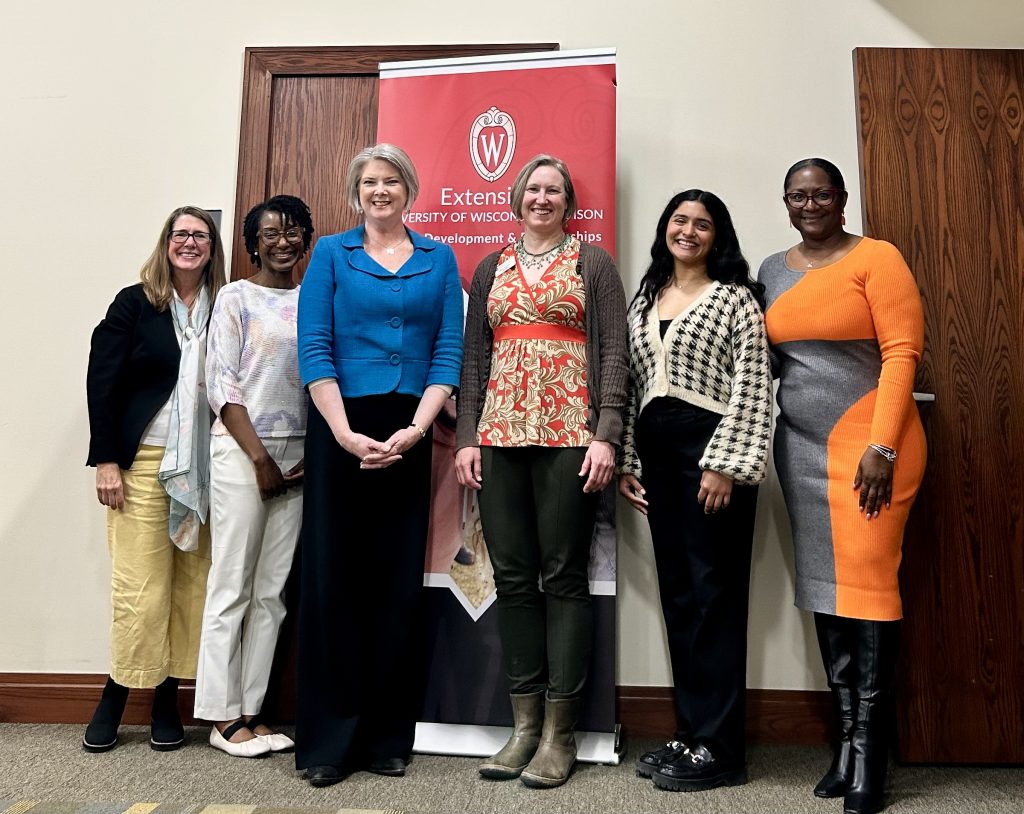
Children’s ability to visit their incarcerated parent in a supportive environment throughout Scotland is the same as in some parts of Wisconsin due to a UW–Madison Division of Extension program, according to visiting lecturer Dr. Nancy Loucks.
In April, Loucks, chief executive of Families Outside, a national nonprofit in Scotland that works on behalf of families affected by imprisonment, spoke to the Division of Extension’s Human Development and Relationships Institute (HDRI). Loucks, who is the Visiting Professor, Centre for Law, Crime & Justice, University of Strathclyde at Oxford University Law School, presented a talk called “Centering Children, Strengthening Families: An Extension Response to Parental Incarceration.”
Scottish Prison Visitors’ Centers
In Scotland, Loucks said, children have the legal right to visit their imprisoned parents. The country’s 11 prison visitors’ centers were created to improve the experience for people visiting a loved one, as well as to support families and offer them impartial advice and information.
“It is recognized that visiting a prison can be a very daunting experience for adults and children,” Loucks said. “Visitors’ centers encourage visits and make it a less frightening and a more welcoming experience.”
The Victorian-era Scottish prison facilities may be gloomy and drab, but visitors’ centers create a more welcoming environment with comfortable furnishings and decor. One visitors’ center hung bright pictures on the walls for a Mothers Day tea.
“Just having that lighter environment makes a huge difference,” Loucks said.
The centers, run by third-party organizations and funded by the Scottish government, have staff who support visitors with information about resources for families — and a cup of tea if they like.
“We’re making sure that families aren’t facing the same problems again and again and again,” Loucks said.
UW–Extension’s ‘The Literacy Link’ Program
Ronda N. Davis, HDRI’s Justice-Involved Families Outreach specialist, spoke about HDRI’s The Literacy Link program, which brings literacy and learning opportunities to young children with parents or caregivers in local correctional systems. The program provides support for families and creates family-friendly spaces in correctional institutions. In child-focused visits, families make time to engage, which is important for child development, Davis said.
“We know the value, the importance and the positive impact of children being able to connect with their loved one when the parent is in prison. We want to make it as stress-free as possible with a child-friendly visiting area, which has toys, a library and a carpet,” Davis said.
In 2024-25, HDRI educators in 11 counties supported 582 parents in jail or prison and their 872 children through The Literacy Link. Davis and her team are collecting data to create a child-friendly visitation model that can be replicated in correctional institutions across the state.
The direct support offered to children, their parents and caregivers in Scotland and in Wisconsin ripples out to those around them.
“Supporting families through difficult circumstances is not just an act of service, it’s an investment in healthier communities,” said HDRI Director Danielle Hairston-Green. “Extension has a unique role in this work because we are rooted in communities and connected to families and committed to translating research into meaningful action.”